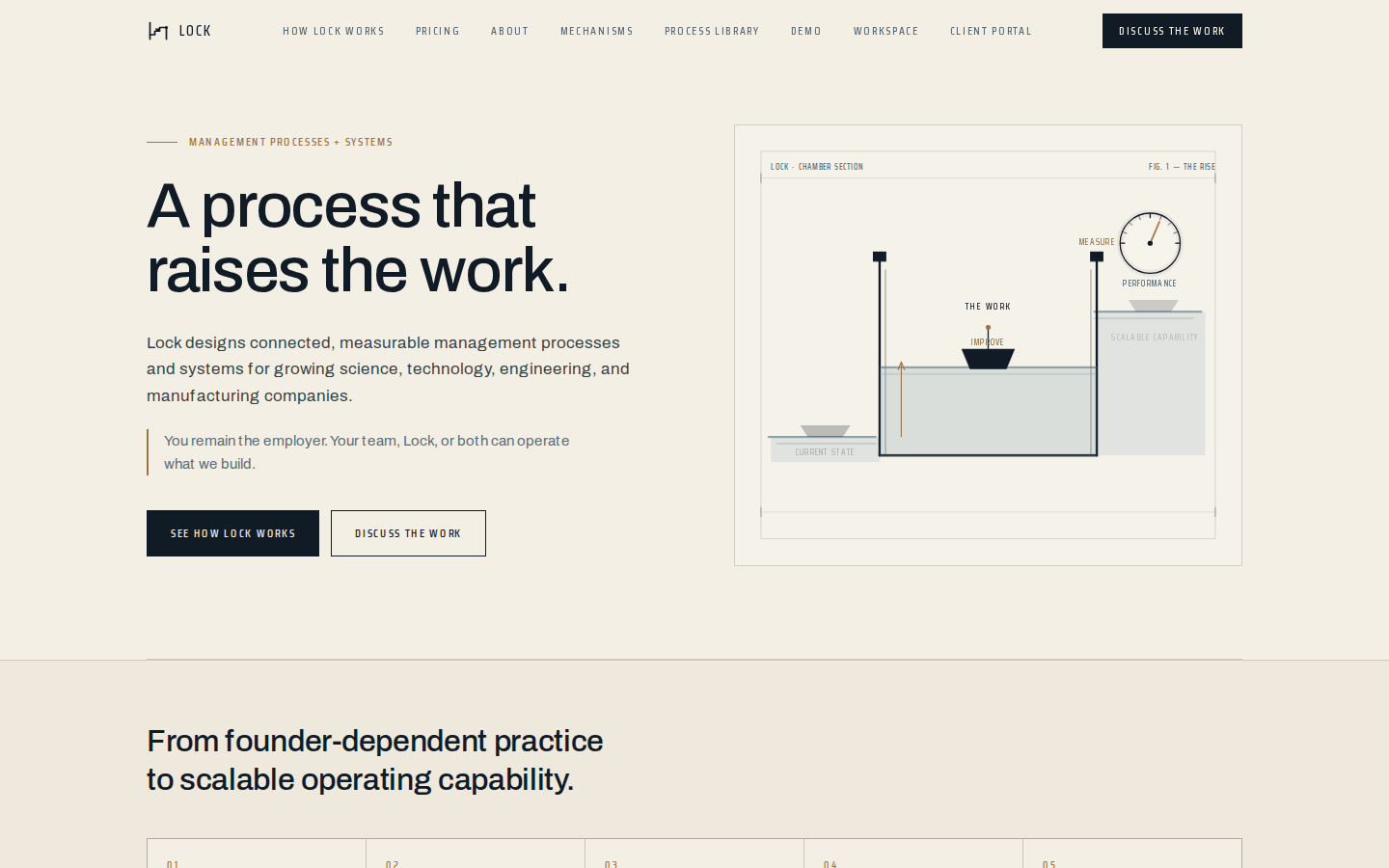
I built Lock as a library of connected management processes for companies that need important work to remain clear when people or circumstances change. A company should not have to rely on one founder or a few experienced managers to remember how hiring, performance, compensation and planning are supposed to work. When those areas are defined separately, decisions drift and changes in one place create trouble elsewhere.
I wanted the process definition itself to carry the knowledge. Each one names the steps, roles, decisions, information and measures, then shows the work it receives and the work that follows.
The library is public so a company can begin with the process it needs and fit that definition to its circumstances. Its structured records preserve a consistent form for people and software. The source material behind the processes is retained at book-and-chapter level, with the aim of making the evidence for each step publicly inspectable. The goal is management work that remains understandable and useful as the company changes.
Who it is for
Lock is for founders, COOs, operations leaders and people leaders who need management work to be clear, teachable and consistent across the company. It suits people responsible for hiring, performance, manager routines, compensation or operating rhythm, especially when decisions and responsibilities vary across teams.
The problem
When management processes live in people’s heads, managers make the same decisions in different ways. Hiring, performance, compensation and planning stop lining up. A change in one area can create problems elsewhere because nobody can see the handoffs, decision rights or shared information. Generic policies and isolated checklists deal with one task at a time. They leave the company without a clear view of how its management work fits together or how to tell whether a process is working.
What I built
Lock is a public library of connected management processes a company can adopt. It covers hiring, performance and development, managers, compensation and operating rhythm. Each process defines its purpose, entry and exit gates, steps, roles, decisions, systems, data, measures and evidence. Related-process links show what the work receives and where it goes next, helping a team see beyond one checklist. Lock stores these elements as structured process records, keeping the same definition legible to people and software. A reader can inspect a process on the web, print it, or export it as Markdown or JSON for use in the company’s own work.
What is new in it
- Each process combines purpose, gates, steps, roles, decisions, systems, data, measures and evidence in one definition, so a team can see what must happen and who is responsible.
- The public pages link the work that comes before and after each process, helping a team change one area with the surrounding management work in view.
- Each definition includes process-specific measures and review cadences, making observation and improvement part of the process instead of an afterthought.
- Process definitions can be read in the browser, printed or exported as Markdown and JSON, giving people and software consistent versions of the same management process.
Where it stands
Lock is becoming a public reference that leaders, search engines and assistants can use to understand how management work connects and how each process should be measured. Live today, the library contains 29 draft processes with related-process links and exports to print, Markdown and JSON. Anyone can inspect and adopt them without signing in.