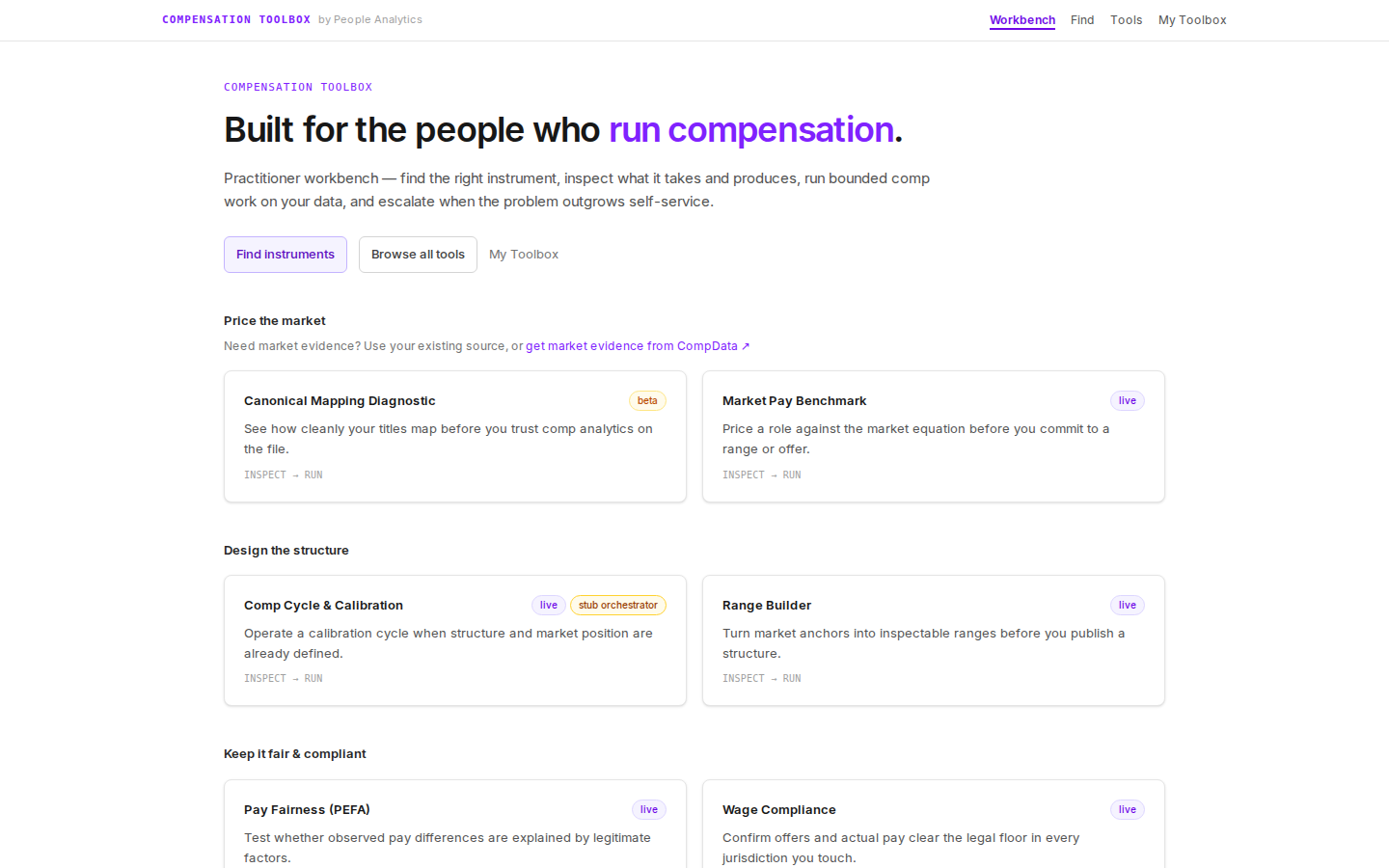
Compensation Toolbox is the workbench I built for in-house teams and consultants making pay decisions. The People Analytics Toolbox came first, and its analytical methods already covered much of this work. Compensation professionals still approached the work with a specific decision in mind and had to find their way through a broader catalogue.
I kept the tested methods and gave compensation work its own place, language, tools and price list. I also wanted the evidence to remain visible. A market figure is more useful when the reviewer can see its source, confidence interval and whether its basis is observed or projected.
The product is becoming a connected place to do compensation work. A job should eventually move from mapping to market evidence, ranges and equity review without being entered again at every step. Defined analysis belongs in the Toolbox. When compensation leaders need organization-wide priorities, scenarios and tradeoffs considered for them, AnyComp provides a separate service.
Who it is for
Compensation Toolbox is for in-house compensation teams and consultants who usually arrive with a specific pay decision. They need to price a role, build ranges, review a pay gap, check equity or prepare a cycle, and they want the relevant tool without searching a general analytics catalogue or rebuilding the work in a spreadsheet.
The problem
Compensation work too often becomes a new spreadsheet every cycle. Teams gather market evidence, map titles, build ranges, test pay differences and prepare recommendations, then have to reconstruct the formulas and assumptions behind the answer when it is challenged or repeated. Professionals who already know the decision they need to make can still lose time searching a broad analytics catalogue for the relevant tool. Careful work remains in a fragile file instead of becoming a method the team can use and explain again.
What I built
Compensation Toolbox is a workbench for compensation professionals who want a tool matched to the pay decision in front of them. It covers market pricing, job mapping, pay ranges, the annual compensation cycle, pay-gap analysis, pay equity and pay structures, with CompData and wage data feeds built in. The site has its own compensation tools and price list while using the same tested methods as the People Analytics Toolbox. For market pay, BLS OEWS/SOC evidence is presented with confidence intervals and an observed or projected basis, so a reviewer can see the source and uncertainty behind the figure. The shared method base keeps calculations consistent across the two workbenches while each remains organized for its own profession.
What is new in it
- The workbench is organized by the pay decision being made, including market pricing, ranges, pay gaps and equity. Compensation professionals can go directly to the relevant tool.
- Market pay uses BLS OEWS/SOC evidence and reports confidence intervals plus an observed or projected basis. Reviewers can see the evidence and uncertainty behind the figure.
- Compensation Toolbox and People Analytics Toolbox use the same tested methods while keeping separate tools, language and price lists for their respective professional audiences.
- The Toolbox contains wage data feeds and location capability. GeoFrame is being built as the place-by-place public home for legal wage floors and geographic pay-range differentials.
Where it stands
The aim is a connected compensation workbench where a job can move from mapping to market evidence, ranges and equity review without being set up again. Today, the live product includes market pay, ranges, pay-gap analysis, pay equity, CompData and wage data feeds, with job mapping in beta and the compensation-cycle tool in an early form.