I built AnyComp for the people who have to choose one pay plan for an entire organization and explain why it fits the priorities they were given. Compensation decisions connect ranges, market position, equity and budget. The calculations can live in a spreadsheet, but the reasoning is often spread across meetings, versions and memories. I wanted the priorities to be explicit before anyone compared options, because that is where the real decision begins. Once those priorities are clear, the team can compare scenarios on consistent terms and receive a recommendation whose limits are stated plainly. I also wanted the executive choice to rest on the same compensation model used for the underlying pay analysis, with its uncertainty stated clearly. The long-term aim is to keep the priorities, scenarios, assumptions and recommendation together so the decision can be revisited when the business changes.
Who it is for
AnyComp is for compensation leaders, CFOs and CHROs who must make one pay decision for the whole organization. It suits teams setting next year’s compensation strategy, balancing budget, market position, equity and talent priorities, then explaining the choice to executives or a board.
The problem
Organization-wide pay decisions are difficult because every choice changes the context for another. Raising market position can alter internal equity, while a fixed budget can force choices among workforce priorities. A spreadsheet can calculate each option without preserving the assumptions and priorities that made one option preferable. When the CHRO, CFO and compensation leader have to choose, they need to show what the plan advances, what it gives up and when the recommendation should be reconsidered.
What I built
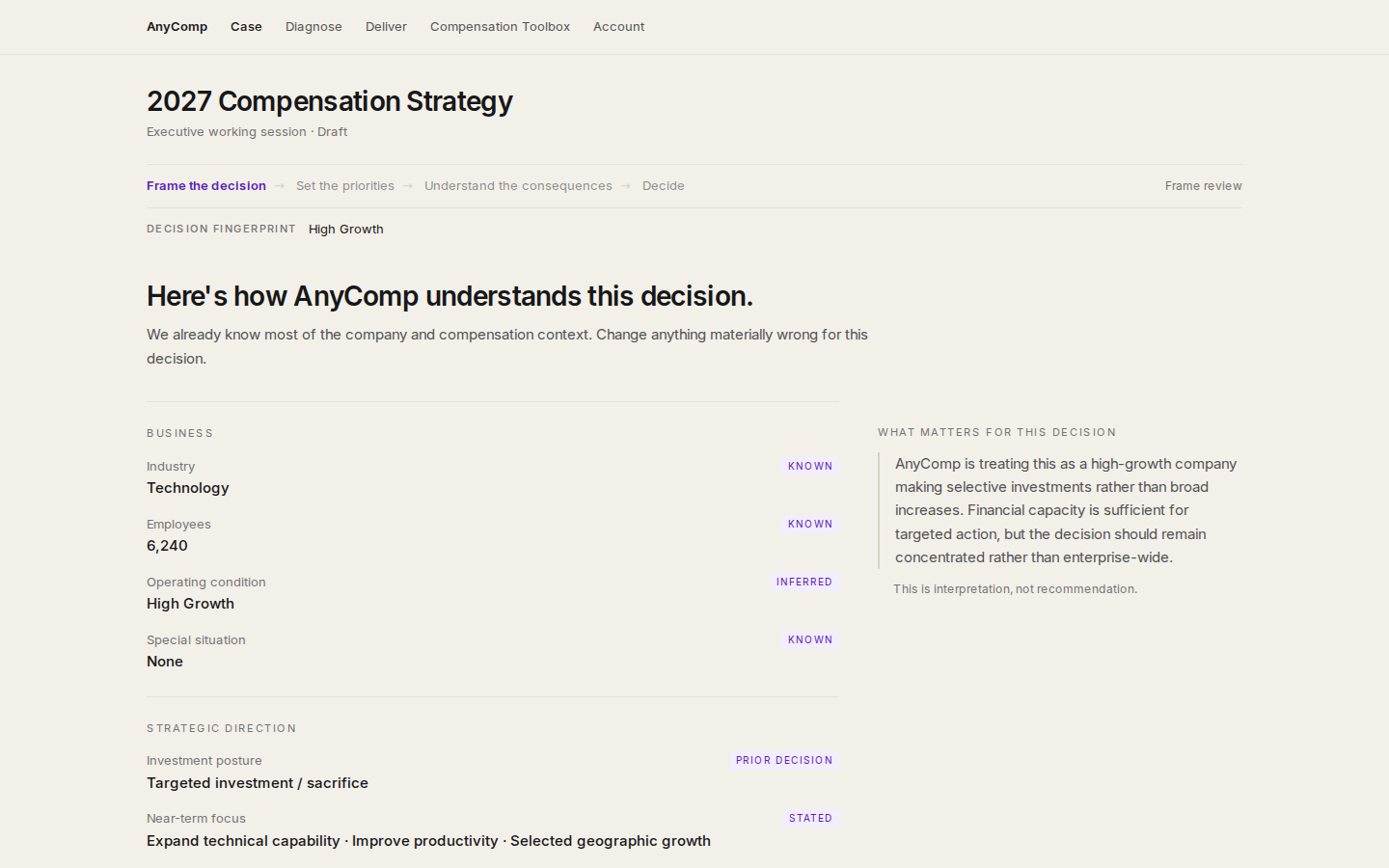
AnyComp is a guided pay-decision service for compensation leaders and executives choosing a plan for the whole organization. In a working session, you set the decision priorities, compare fitting scenarios on your own pay data and receive a recommendation that holds while those priorities hold. The session states the assumptions and tradeoffs alongside the recommendation, giving the team a clear reason for its choice. AnyComp uses the same pay model as CompData, the related compensation-data product. That model treats market pay as a factor-decomposed distribution and states its uncertainty, so the organization-level recommendation rests on an analytical model that can be explained in plain terms.
What is new in it
- The recommendation is conditional: it applies while the priorities behind it still apply. Leaders can state the basis for the choice and know when the decision needs to be worked again.
- Priorities are set before scenarios are compared, and each option is assessed against the same criteria. This keeps budget, workforce and market tradeoffs visible during the decision.
- AnyComp shares CompData’s factor-decomposed pay model, which represents market pay with stated uncertainty. The executive recommendation and the underlying compensation analysis therefore use the same method.
Where it stands
AnyComp is being built so each pay decision can keep its priorities, scenarios, assumptions and recommendation together as a durable record leaders can revisit when conditions change. It is live today as a concierge engagement on customer data, where the working session already connects priorities to fitting options and a conditional recommendation. Saving sessions is in progress.